
The Rise of Mild Autism in the United States and Taiwan: Prevalence, Inclusion, and Experimental Education or Homeschooling Introduction
Dr. Jenny Wilkins
June 29, 2026
Introduction
Autism spectrum disorder is a heterogeneous neurodevelopmental condition marked by wide variation in social-communication differences, restricted interests, and support needs. Population-level surveillance has increasingly identified autism in children with relatively mild functional challenges, shifting the profile of diagnosed cases over time. This change is important because the rise in identified prevalence may reflect not only better recognition but also a broader inclusion of individuals whose difficulties are less apparent in daily life.
The United States and Taiwan offer a useful comparison because both show strong increases in autism identification, yet both also lack complete information on school placement and family response. In the United States, the CDC’s Autism and Developmental Disabilities Monitoring Network reported that 32.2 per 1,000 8-year-old children were identified with ASD in 2022. In Taiwan, available reports indicate that most autistic individuals are categorized as mild, while preschool inclusion for children with special needs is very high. Despite these similarities, neither system fully tracks how educational settings differ by symptom severity or adaptive functioning.
The Rise of Mild Autism in the United States and Taiwan: Prevalence, Inclusion, and Experimental Education or Homeschooling United States Prevalence Trends
United States Prevalence Trends
U.S. autism surveillance shows a sustained rise in identified prevalence over the past two decades. The CDC reported that 32.2 per 1,000 8-year-old children were identified with ASD in 2022, equivalent to about 1 in 31 children. More importantly for this analysis, a recent study using ADDM Network data from 2000 to 2016 found that the increase in autism prevalence was entirely concentrated among children with mild or no significant adaptive challenges.
The study also reported that autism prevalence among children with mild, borderline, or no significant adaptive challenges rose from 5.1 per 1,000 in 2000 to 17.6 per 1,000 in 2016, while prevalence among children with moderate to profound challenges declined slightly from 1.5 to 1.2 per 1,000. The authors concluded that the increase in autism prevalence between 2000 and 2016 was confined to autism with milder phenotypes. This finding is central to understanding current prevalence trends because it suggests that the expanding autism population is not evenly distributed across levels of support need.
The Rise of Mild Autism in the United States and Taiwan: Prevalence, Inclusion, and Experimental Education or Homeschooling: Taiwan Prevalence and Inclusion
Taiwan Prevalence and Inclusion
Taiwan’s available data points in a similar direction. According to the figures referenced here, 79% of autistic individuals in Taiwan are categorized as having mild autism. While the underlying classification system may differ from the U.S. adaptive-functioning framework, the overall pattern is consistent: most identified cases appear to fall on the lower-support end of the spectrum.
Taiwan also reports high early inclusion rates for children with special needs. A study of itinerant special education services notes that by 2023, 94% of preschoolers with special needs were enrolled in regular kindergarten classes, reflecting a strong commitment to inclusive education at the preschool level. This is a significant indicator of access, but it does not address whether children with autism remain in mainstream settings as academic and social demands increase.
The main limitation is that the available inclusion statistic is not autism-specific and does not address experimental education or homeschooling, nor does it capture later educational transitions. As a result, Taiwan’s preschool inclusion data may overstate the continuity of mainstream placement if families later shift to alternative arrangements because school support is insufficient.
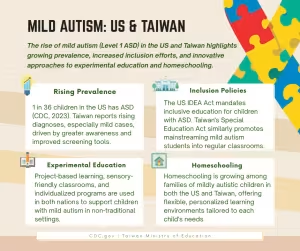
Mild Autism: the US vs. Taiwan
The Rise of Mild Autism in the United States and Taiwan: Prevalence, Inclusion, and Experimental Education or Homeschooling: Educational Placement as a Missing Variable
Educational Placement as a Missing Variable
A major weakness in both countries is the lack of linked data connecting autism severity, adaptive functioning, and educational placement. The U.S. study measured prevalence by adaptive level but did not track whether children remained in mainstream schools, entered special education settings, or were educated at home. Taiwan’s data similarly document early inclusion without specifying how many autistic children are in experimental education or homeschooling, or how many later leave mainstream classrooms.
This missing variable matters because educational placement is not merely an administrative category. It shapes access to instruction, social participation, therapy coordination, and family stress. A child with mild autism may function academically in a standard classroom yet still experience severe sensory overload, social exclusion, or bullying. Without placement data, prevalence statistics cannot tell us whether systems are effectively supporting these children.
The gap also limits cross-country comparisons. One system may appear more inclusive because of higher reported enrollment, while another may appear more fragmented because homeschooling is more common yet unmeasured. In both cases, the lack of longitudinal educational data reduces the policy value of autism surveillance.
The Rise of Mild Autism in the United States and Taiwan: Prevalence, Inclusion, and Experimental Education or Homeschooling: Homeschooling and Family Response
Homeschooling and Family Response
My experience on the homeschooling application board committee in Taiwan highlights a reality that surveillance data often overlook: families make educational decisions in response to lived conditions, not abstract categories. For many autistic children, homeschooling is not a rejection of education but a response to school environments that are socially unsafe, instructionally inflexible, or under-resourced.
The most common reasons families choose homeschooling include bullying, unique learning needs that conventional classrooms do not meet, and limited support from schools. These reasons are especially relevant for children with milder autism, whose difficulties may be overlooked because they are not always evident during a brief school observation. In such cases, the child may appear capable on paper while struggling significantly in daily school life.
The Rise of Mild Autism in the US and Taiwan
The Rise of Mild Autism in the United States and Taiwan: Prevalence, Inclusion, and Experimental Education or Homeschooling: Policy and Research Implications
Policy and Research Implications
The existing evidence suggests that autism policy should move beyond prevalence alone. In both the United States and Taiwan, future research should connect diagnosis with adaptive functioning, school placement, and educational transitions over time. Only then can researchers determine whether rising autism prevalence, especially among milder cases, reflects successful inclusion or unmet need.
For policymakers, the implication is clear. Inclusive education cannot be judged solely by the proportion of children enrolled in regular classrooms at a single point in time. It must also be evaluated based on retention, student well-being, access to support services, and family satisfaction. If children are formally included but practically unsupported, inclusion exists in name only.
For researchers, the next step is to build data systems that track autistic students across educational settings. These systems should distinguish among mainstream schooling, special education placement, and experimental education or homeschooling, and should do so in relation to functional profile and family context. Without this information, the true impact of rising mild autism prevalence will remain obscured.
The Rise of Mild Autism in the United States and Taiwan: Prevalence, Inclusion, and Experimental Education or Homeschooling: Conclusion
Conclusion
The United States and Taiwan both show a growing concentration of autism diagnoses among individuals with milder presentations. In the U.S., autism prevalence rose sharply among children with mild, borderline, or no significant adaptive challenges between 2000 and 2016, while Taiwan reports that most autistic individuals are categorized as mild. At the same time, Taiwan’s high preschool inclusion rate and the U.S. adaptive-functioning analysis do not indicate where these children are educated or how many families turn to experimental education or homeschooling.
This limitation is not merely technical. It shapes how societies understand inclusion, how schools respond to students' needs, and how families navigate educational systems. Until researchers and policymakers collect data on school placement alongside data on prevalence and severity, the educational lives of many autistic children will remain invisible within the very systems meant to serve them.
The Rise of Mild Autism in the United States and Taiwan: Prevalence, Inclusion, and Experimental Education or Homeschooling: References
References
FACT. (2025). 2025 最新自閉症人數比例 (第一季) [Latest autism population proportion Q1 2025].
Furnier, A., Gangnon, R. R., & Schaffer, N. (2025). Trends over time in the prevalence of autism by adaptive and cognitive levels.
Lin, L.-J., Sung, L.-Y., & Hwang, A. W. (2010). Ten-year trend analysis of autism severity: A nationwide population-based study in Taiwan.
Taipei City Government. (2023). A study on the models of itinerant special education services in Taiwan.
National Institute of Mental Health. Autism spectrum disorder (ASD).
Taiwan Ministry of Education. (n.d.). National Special Education Information Network.
The Transmitter. (2024, September 30). Rise in U.S. autism prevalence stems mainly from “mild” cases.